What to wear
What to wear on an Icelandic glacier hike — and what gets people turned away
Crampons are supplied. Boots are not. That one sentence explains most of the people standing disappointed in a car park at Skaftafell. Here is the full list of what the operator provides, what you have to bring, and the three things people always get wrong.
Quick answer
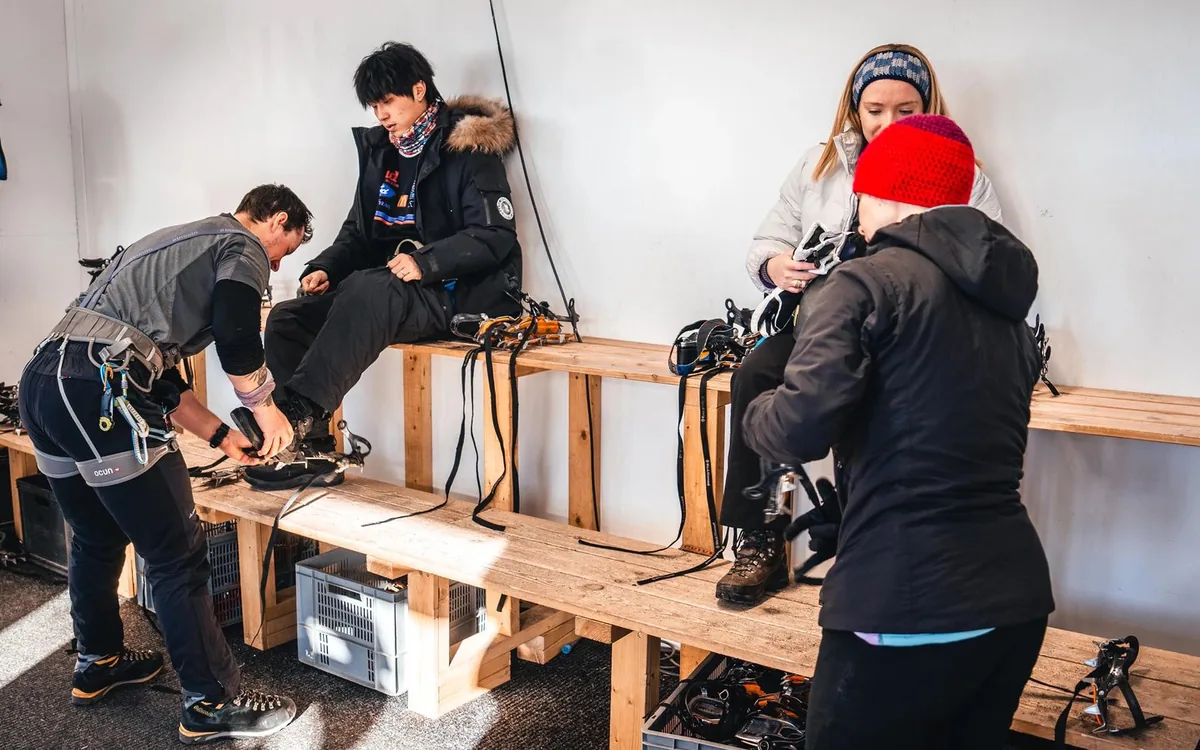
Waterproof boots above the ankle are the one thing you must bring, and the one thing most operators do not supply. Crampons, a harness and an ice axe are included on every walk on this site. After the boots, the two things people underestimate are a genuinely windproof shell — a glacier makes its own wind — and sunglasses, which matter as much in February as in July.
The kit list, at a glance
- Supplied on every walk
- Crampons, harness, ice axefitted at the trailhead
- Often supplied
- Helmeton routes that need one
- You must bring
- Waterproof boots above the ankleguides do turn people away
- Strongly recommended
- Waterproof trousersand a windproof shell
- Gloves
- A pair that survives being wetyou will touch the ice
- Head
- A thin hat that fits under a helmeta thick one will not
- Eyes
- Sunglasses, all yearbare ice under low sun is dazzling
- Carry
- Water and something to eatthere is nothing up there
- Leave behind
- Tripod, umbrellayou need both hands
- Renting boots
- Easiest in Reykjavíkbefore you drive east
Why boots are the whole problem
A crampon needs something to grip
Stiff sole, real heel, above the ankle. Rent them in the capital if you need to.
A crampon is a steel frame with ten or twelve points that straps onto a boot. The straps tension against a reasonably stiff sole and hook over a defined heel and toe. A trainer has neither. On a soft sole the crampon rolls sideways the first time you weight an edge, which on glacier ice is exactly how people get hurt.
So guides check footwear at the meeting point and they do turn people away. This is not officiousness; it is the same check any mountain guide would do. What they want is a stiff-ish sole, a real heel, and an upper above the ankle so the boot does not fill with meltwater and grit on the moraine.
If you did not bring boots, rent them in Reykjavík before you drive. Outdoor shops in the capital hire them by the day for very little. Finding a pair at Skaftafell at eight in the morning is not a plan. Some operators do include boot hire and a few advertise it — read the inclusions on the specific listing rather than assuming, because it varies between tours from the same company.
The list
What to wear, from the skin out
Layers, not thickness. A glacier makes its own wind and the temperature is not the issue.
- Base layer: merino or synthetic, never cotton
Cotton holds water against the skin and stops insulating the moment it is damp, and you will sweat on the walk in. This is the cheapest useful upgrade to a winter wardrobe in Iceland.
- Mid layer: a fleece or light down
One in summer, two in winter. Expect to carry it more than wear it on the way up and to want it the moment the group stops.
- Outer: a windproof waterproof shell
This is the important one. The wind coming off a glacier is the reason people get cold up there, not the air temperature. A shell that actually blocks it beats a thick coat that does not.
- Waterproof trousers
The moraine is wet and you will sit on ice at some point. Jeans on a glacier are miserable within twenty minutes and stay that way for the rest of the day.
- Gloves that work wet
You will put a hand on the ice repeatedly and grip an axe. Wool alone comes back soaked. A waterproof outer pair with a thin liner underneath is the answer.
- A thin hat and a buff
The hat has to fit under a helmet on the routes that use one. A buff does more for comfort in wind than almost anything else you can carry.
- Sunglasses, in every month
Bare ice under a low winter sun is as bright as ice under a high summer one, and in June that sun is up for twenty hours. This is the single most forgotten item.
Everything above is for a glacier walk. If your booking includes ice climbing, the axes and helmet are supplied too — and the gloves matter more.
Ice climbing in full→Three things people always get wrong
The mistakes that show up in the reviews
Dress for wind, keep both hands free, and bring a hat that fits under a helmet.
Dressing for the air temperature rather than the wind. A glacier generates katabatic wind: cold air draining downhill off the ice. It is why five degrees on a glacier feels colder than five degrees in the car park, and why a windproof shell does more than an extra fleece.
Bringing something that needs a hand. You want both hands free on the moraine and you will want them again on the ice. A camera bag worn across the body, or a pocket you can reach with gloves on, is the whole answer. A tripod is dead weight and there is nowhere to set it up without being in somebody else’s line.
Wearing a thick hat. On routes that use a helmet it will not fit underneath, and people end up carrying it for three hours. A thin beanie or a buff solves it and weighs nothing.
Common questions
What to wear on a glacier hike, answered
What should I wear for a glacier hike in Iceland?
Waterproof boots above the ankle, waterproof trousers, a windproof waterproof shell over one or two warm layers, gloves that work wet, a thin hat and sunglasses. Crampons, a harness and an ice axe are supplied.
Are crampons provided?
Yes, on every walk on this site, along with a harness and an ice axe, and a helmet on the routes that need one. Boots are the exception.
Can I wear trainers on a glacier hike?
No. Crampons cannot be strapped safely to a soft sole and guides do turn people away. Rent boots in Reykjavík before you drive if you did not bring any.
How cold is it on a glacier?
In summer around five to ten degrees, in winter often below freezing — but the wind matters more than the number. Cold air drains downhill off the ice and a windproof shell is the single most useful layer.
Do I need waterproof trousers?
Strongly recommended. The moraine is wet, you will sit on ice at some point, and jeans up there are miserable within twenty minutes.
Do I need sunglasses in winter?
Yes. Low winter sun on bare ice is genuinely dazzling, and the walk out often faces straight into it.
Go deeper
More on walking on an Icelandic glacier
What a glacier hike in Iceland costs
Seventeen walks priced per person and per hour, from $91 to $1,803.
SkaftafellThe Skaftafell glacier hike
Falljokull and Vatnajokull from the national park, and which route is which.
VerdictThe best glacier hike in Iceland
Seventeen walks ranked for one decision, with a straight answer at the end.
SolheimajokullSolheimajokull glacier hike
The closest glacier to Reykjavik, and the one most day tours actually use.
Glacier walksGlacier walks in Iceland
What a guided walk on the ice involves, and how it differs from a hike.
FalljokullThe Falljokull glacier hike
Easy, advanced and extended on the same tongue of ice — the real difference.