Glacier Hike Iceland
See tours

When to go

The best time for a glacier hike in Iceland, month by month

This is one of the few things in Iceland that runs every month of the year, which makes the question harder rather than easier: there is no closed season to rule anything out. What the months give you instead are two genuinely different glaciers — the bare one and the snow-covered one.

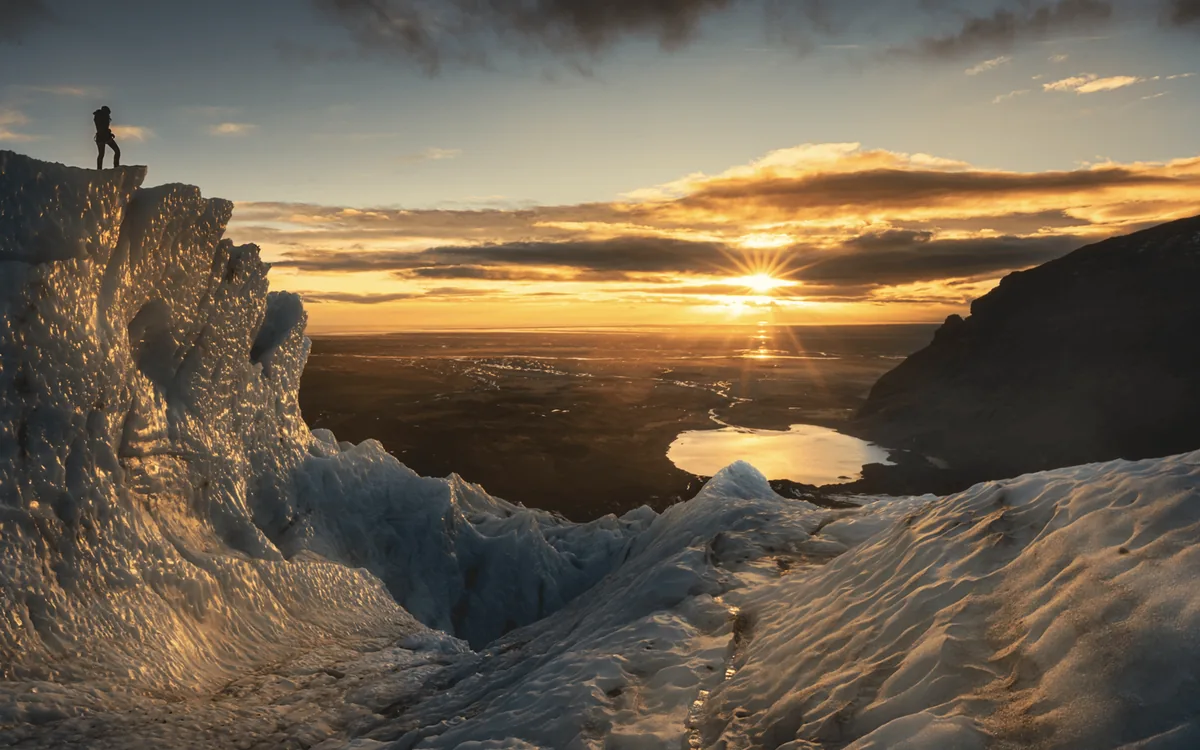
Low sun over a glacier ridge in Iceland

Quick answer

June to September is the best window for the ice itself: the winter snow has melted off and the bare glacier is exposed, with crevasses, runnels and blue channels all visible. December to February covers the same glacier in snow, shortens the routes and gives you about five hours of daylight — but adds ice caves and the aurora. March to May and October are the quiet shoulders, with the ice improving through spring.

The year, at a glance

Best for the ice
June to Septemberbare surface, everything visible
Longest days
June and Julylight effectively around the clock
Best compromise
Septemberbare ice and the first aurora nights
Quietest
May and Octobershoulder weeks, same ice
Winter
December to Februarysnow cover, five hours of light
Ice caves
November to Marchwinter only, and one walk here pairs with one
Aurora
September to Aprilneeds dark nights, not cold ones
Routes shortened
Midwintersnow bridges make guides conservative
Prices
Steadythey do not swing much by season here
Cancellation
Free all yearon all seventeen walks

Month by month

Four seasons, four different glaciers

This is not a good season and a bad one. It is two different activities sharing a name.

Jun – Sep

Bare ice and long light

The best months for what a glacier actually looks like. The previous winter’s snow has melted off the surface and everything is exposed: crevasses open and blue, meltwater runnels cut across the ice, ash bands legible, moulins visible. Guides can take longer lines because they can see the ground. Daylight is effectively unlimited in June and July. Every route on this page runs and the long ones are at their best.

Mar – May

The ice improving

Snow melting off week by week, so the glacier gets better through the spring. Daylight back to a workable length, far fewer people than summer, and the south coast roads easy again. May in particular is one of the better-kept secrets in this niche.

Oct – Nov

Quiet, and the aurora returns

Bare ice still exposed for much of October, nights dark enough for the aurora, and the crowds gone. Weather cancels more often than in summer and the days shorten fast, so the longer routes start disappearing from the schedule towards the end of November.

Dec – Feb

Snow, ice caves and short days

The glacier is under snow, which hides the structure but makes the landscape extraordinary. Routes are shorter and more conservative because snow bridges crevasses. About five usable hours of daylight in the south-east. In exchange: the ice caves are open and the aurora season is at its peak.

Choosing between the two glaciers

Same ice, two completely different days

Summer is the geology. Winter is the landscape. Pick on the rest of your trip.

The honest way to frame this is that Iceland sells you two products under one name.

The summer glacier is a geology lesson you walk across. You can see how the ice is built, where the water goes, which eruption left which black band. Guides take longer routes because nothing is hidden. If somebody says a glacier hike was the best thing they did in Iceland, they usually went in summer.

The winter glacier is a landscape. Snow smooths everything into white, the light is low and gold all day, and the routes are shorter because a guide will not cross ground they cannot read. It is more beautiful and less interesting, and it comes bundled with the two things summer cannot offer: an ice cave underneath and a green sky that evening.

So the answer depends entirely on what else is in the trip. Coming for the glacier: summer. Coming for a winter week with caves and aurora in it: winter, and book a shorter walk without resentment.

Every trip, current fare

Every walk, all of which run all year

The routes shorten in midwinter but nothing closes. Prices are broadly stable across the seasons on this page.

HikeLengthPriceGlacierCost per hourRating
Vatnajokull: Skaftafell Glacier HikeThe cheapest guided walk on the ice3 h$91Vatnajökull$30.334.5 · 93
Skaftafell: Falljokull Glacier Easy Group HikeThe easy Falljökull group hike, 1,674 reviews3 h$101Falljökull$33.674.6 · 1,674
Sólheimajökull: Guided Glacier HikeThe closest glacier to Reykjavík3 h$107Sólheimajökull$35.674.6 · 3
From Reykjavík: Waterfalls, Black Beach & Glacier Day TripWaterfalls, black beach and a glacier, rated 4.912 h$136Sólheimajökull$11.334.9 · 502
Jökulsárlón: Vatnajökull Glacier Guided Hiking TourVatnajökull from the lagoon side4.5 h$140Vatnajökull$31.114.8 · 1,054
Skaftafell: Half-Day Vatnajökull National Park Glacier HikeHalf a day in the national park, small group4 h$153Vatnajökull$38.255.0 · 143
Skaftafell: Ice Cave Tour and Glacier HikeA glacier walk and an ice cave, most reviewed here4 h$153Falljökull$38.254.5 · 1,962
Skaftafell National Park: Falljokull Glacier Advanced HikeThe advanced Falljökull route5 h$155Falljökull$31.004.8 · 1,181
Skaftafell Glacier Explorer - Extended Small Group TrekFive hours and a longer route on the ice5 h$158Vatnajökull$31.604.8 · 375
From Reykjavik: South Coast & Glacier HikeThe south coast day with a glacier walk in it12 h$186Sólheimajökull$15.504.8 · 504
Reykjavík: Glacier Hike, Waterfalls, & Black Sand BeachGlacier, waterfalls and Reynisfjara in twelve hours12 h$191Sólheimajökull$15.924.7 · 120
Reykjavík: Sólheimajökull Glacier Hike & Ice Climbing IntroA walk plus a first go at ice climbing5.5 h$199Sólheimajökull$36.184.8 · 458
Skaftafell: Glacier XTreme - Hike & Ice Climbing AdventureThe longest day on the ice here7.5 h$230Falljökull$30.674.9 · 83
Sólheimajökull Ice Climbing TourIce climbing on Sólheimajökull, no walk4 h$273Sólheimajökull$68.254.8 · 52
Glacier Hike, South Coast Iceland, Black Beach & Sky LagoonGlacier, black beach and a hot lagoon to finish10 h$287Sólheimajökull$28.705.0 · 5
From Reykjavik: Fire And Ice Helicopter Tour with 2 LandingsTwo glacier landings by helicopter2 h$913Two landings$456.504.7 · 158
Reykjavík: South Coast Glacier Private ExpeditionA private twelve-hour south coast expedition12 h$1,803South coast$150.25New
Summer in full

Choosing your month

Six situations and the month that fits

The right answer depends on what else you want out of the trip.

  • You want to see the glacier properly

    June to September. Bare ice, long routes, and everything visible. This is the honest answer and it is the opposite of what most people assume.

  • You want the aurora as well

    September, or late March. Both have dark-enough nights and enough daylight for a proper walk, which December does not.

  • You want an ice cave too

    November to March, and book the Skaftafell walk that pairs with one. Accept a shorter walk in exchange.

  • You want it quiet

    May or October. Same ice as the peak months for much of both, and a fraction of the people.

  • You are driving the south coast

    Any month from April to October. In midwinter the driving is the hard part, not the walking.

  • You have one fixed week

    Book whatever is open in that week, and book the capped small groups early. Free cancellation means an early booking risks nothing.

Common questions

The best time for a glacier hike, answered

When is the best time for a glacier hike in Iceland?

June to September for the ice itself, because the winter snow has melted off and the bare glacier is exposed. December to February if you want an ice cave and the aurora as part of the same trip.

Can you hike a glacier in Iceland in winter?

Yes, all seventeen walks on this site run in winter. Routes are shorter because snow bridges crevasses and there are only about five hours of daylight, but nothing closes.

Is summer or winter better?

Summer, if the glacier is the point. Winter, if the trip is about caves and aurora and the walk is one part of it.

What is the quietest month?

May or October. Both have much of the bare ice of the peak season and a fraction of the people, and accommodation on the south coast is easier.

How much daylight is there in December?

About four to five usable hours on the south coast, which is why winter departures cluster around midday and why the longer routes disappear from the schedule.

Do prices change with the season?

Not much on this page. What changes is how long the routes are and how much of the glacier you can see.

Go deeper

More on walking on an Icelandic glacier

Skaftafell: Ice Cave Tour and Glacier Hike

4.5 · 1,962 reviews · Free cancellation 24 h

$153most reviewed Check dates