Glacier walks
Glacier walks in Iceland: what actually happens up there
Glacier walk and glacier hike are the same product sold under two names, and neither tells you what the two hours on the ice are like. This page is what the surface is actually like underfoot, what the crampons do, what the guide is doing, and the six things people are surprised by.
Quick answer
A guided glacier walk in Iceland is two to three hours on the ice with crampons, a harness and an ice axe supplied, at a pace set by the guide. No experience is assumed on the easy routes, the crampon lesson takes about two minutes, and the ground is far more broken and interesting than it looks from the road. Walks start at $91 and run all year.
A glacier walk, at a glance
- Time on the ice
- About 2 hourson almost every listing here
- Supplied
- Crampons, harness, ice axeon all seventeen walks
- You bring
- Waterproof boots above the ankleand waterproof trousers
- Experience needed
- None, on the easy routesthe crampon lesson takes two minutes
- Group
- Roped or in a lineeight walks here cap the numbers
- The approach
- 15–30 min on footover moraine, before the ice
- Season
- All yearsummer exposes the bare ice
- From
- $91three hours at Skaftafell
- Glaciers used
- Falljökull, Vatnajökull, Sólheimajökullthree tongues, two areas
- Cancellation
- Free on all seventeenbooked through GetYourGuide
What the surface is like
Nothing about it is flat, and that is the point
Runnels, crevasses, moulins and ash. The flat white ramp is an illusion from the road.
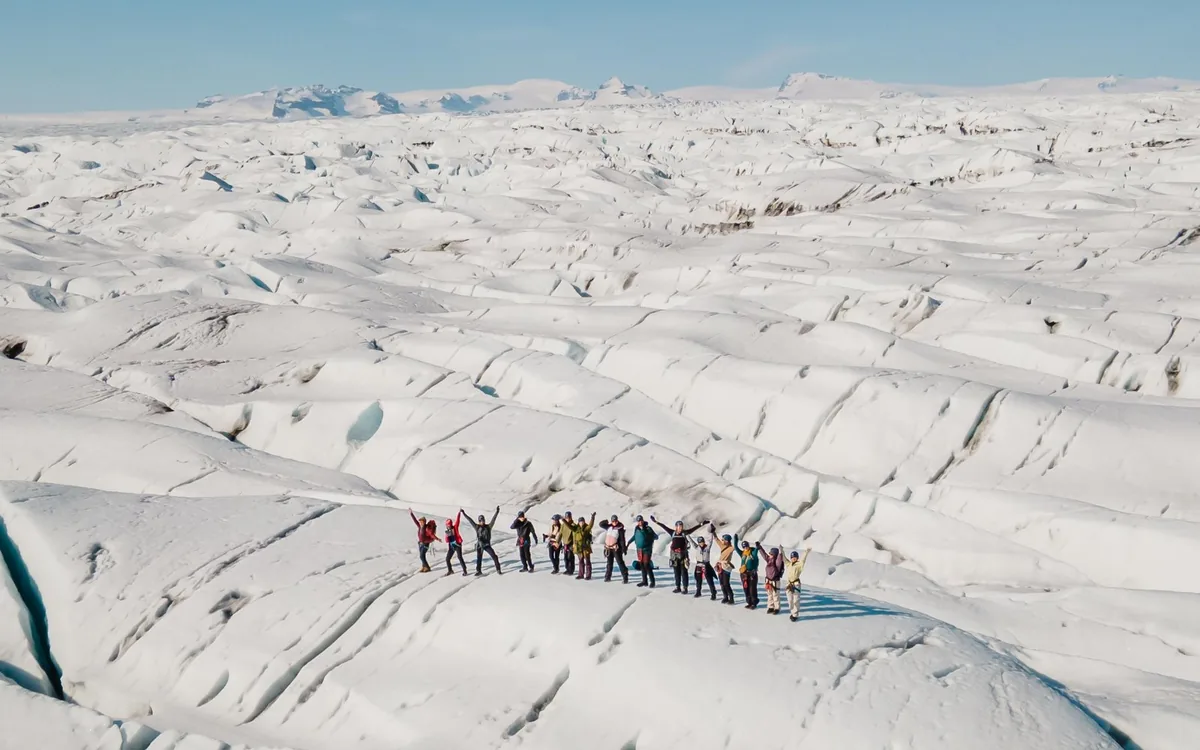
From the Ring Road a glacier tongue looks like a dirty white ramp. Standing on it, the first thing that registers is that the whole surface is textured: long parallel runnels cut by meltwater, ridges between them, and everywhere small hollows where water has pooled and refrozen.
Then the bigger features. Crevasses, where the ice has been stretched over uneven ground beneath and has cracked, blue at the bottom and usually deeper than they look. Moulins — near-vertical shafts where surface meltwater disappears into the glacier, sometimes with the sound of water still audible far below. Guides keep groups well clear of both and will usually show you one from a safe distance, because it is the single most memorable thing up there.
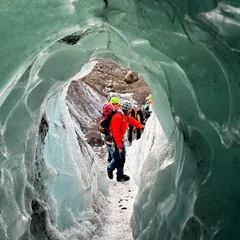
And colour. Not the postcard white: grey and black where volcanic ash has been exposed, dirty brown where the ice is carrying rock, and then sudden clean blue wherever a crack or a runnel has cut through into dense old ice. The blue is the same physics as in an ice cave — air squeezed out over centuries, leaving ice that absorbs everything except the short wavelengths.
What the crampons do
Two minutes of instruction, and then you stop thinking about them
Flat foot, feet apart. That is the technique, and boots are the requirement.
A crampon is a steel frame with ten or twelve downward points and two more angled forward at the toe. It straps over your boot at the trailhead, and the entire technique for a glacier walk is: put your foot down flat so every point engages, and walk with your feet slightly further apart than usual so you do not catch one trouser leg with the other foot.
That is genuinely all of it. The first fifty metres feel absurd — the points grip so completely that your body keeps expecting a slip that does not come. After that almost everybody forgets they are wearing them, which is exactly the intention.
What the crampons need from you is a boot. The straps tension against a stiff-ish sole and hook over a defined heel and toe. A trainer has neither, which is why guides check footwear at the meeting point and turn people away. It is the same check any climbing guide would do, and it is not negotiable.
The harness is there so the guide can rope the group in places where the ground is broken; on many easy routes it is worn but never used. The ice axe is mostly a walking aid and a probe. Nobody is going to teach you to self-arrest on a three-hour walk.
Every trip, current fare
Every walk, from the shortest to the longest
The column worth reading is length, and then cost per hour. Almost everything here gives you about two hours on the ice; the tours differ in what surrounds them.
| Hike | Length | Price | Glacier | Cost per hour | Rating |
|---|---|---|---|---|---|
| Vatnajokull: Skaftafell Glacier HikeThe cheapest guided walk on the ice | 3 h | $91 | Vatnajökull | $30.33 | 4.5 · 93 |
| Skaftafell: Falljokull Glacier Easy Group HikeThe easy Falljökull group hike, 1,674 reviews | 3 h | $101 | Falljökull | $33.67 | 4.6 · 1,674 |
| Sólheimajökull: Guided Glacier HikeThe closest glacier to Reykjavík | 3 h | $107 | Sólheimajökull | $35.67 | 4.6 · 3 |
| From Reykjavík: Waterfalls, Black Beach & Glacier Day TripWaterfalls, black beach and a glacier, rated 4.9 | 12 h | $136 | Sólheimajökull | $11.33 | 4.9 · 502 |
| Jökulsárlón: Vatnajökull Glacier Guided Hiking TourVatnajökull from the lagoon side | 4.5 h | $140 | Vatnajökull | $31.11 | 4.8 · 1,054 |
| Skaftafell: Half-Day Vatnajökull National Park Glacier HikeHalf a day in the national park, small group | 4 h | $153 | Vatnajökull | $38.25 | 5.0 · 143 |
| Skaftafell: Ice Cave Tour and Glacier HikeA glacier walk and an ice cave, most reviewed here | 4 h | $153 | Falljökull | $38.25 | 4.5 · 1,962 |
| Skaftafell National Park: Falljokull Glacier Advanced HikeThe advanced Falljökull route | 5 h | $155 | Falljökull | $31.00 | 4.8 · 1,181 |
| Skaftafell Glacier Explorer - Extended Small Group TrekFive hours and a longer route on the ice | 5 h | $158 | Vatnajökull | $31.60 | 4.8 · 375 |
| From Reykjavik: South Coast & Glacier HikeThe south coast day with a glacier walk in it | 12 h | $186 | Sólheimajökull | $15.50 | 4.8 · 504 |
| Reykjavík: Glacier Hike, Waterfalls, & Black Sand BeachGlacier, waterfalls and Reynisfjara in twelve hours | 12 h | $191 | Sólheimajökull | $15.92 | 4.7 · 120 |
| Reykjavík: Sólheimajökull Glacier Hike & Ice Climbing IntroA walk plus a first go at ice climbing | 5.5 h | $199 | Sólheimajökull | $36.18 | 4.8 · 458 |
| Skaftafell: Glacier XTreme - Hike & Ice Climbing AdventureThe longest day on the ice here | 7.5 h | $230 | Falljökull | $30.67 | 4.9 · 83 |
| Sólheimajökull Ice Climbing TourIce climbing on Sólheimajökull, no walk | 4 h | $273 | Sólheimajökull | $68.25 | 4.8 · 52 |
| Glacier Hike, South Coast Iceland, Black Beach & Sky LagoonGlacier, black beach and a hot lagoon to finish | 10 h | $287 | Sólheimajökull | $28.70 | 5.0 · 5 |
| From Reykjavik: Fire And Ice Helicopter Tour with 2 LandingsTwo glacier landings by helicopter | 2 h | $913 | Two landings | $456.50 | 4.7 · 158 |
| Reykjavík: South Coast Glacier Private ExpeditionA private twelve-hour south coast expedition | 12 h | $1,803 | South coast | $150.25 | New |
Glacier walk and glacier hike mean the same thing in Iceland. Some operators use one word, some the other, and a few use both in the same listing.
Which walk is best→Six surprises
What people say afterwards that nobody told them
None of this is in a listing, and all six come up constantly.
- It is louder than you expect
Glacier ice creaks, ticks and occasionally cracks. On a still day you hear meltwater running under your feet. It is not a warning sign and the guides are listening to it constantly.
- It is warmer than you expect, until it is not
Walking uphill in crampons generates real heat. Then the group stops for the guide to explain something and the wind finds you. This is why layers beat one thick coat.
- The ice is dirty, and that is interesting
Ash bands, grit and rock carried along by the ice. On Sólheimajökull you are reading the eruption history of Katla under your boots.
- Two hours is enough
Almost nobody comes off a glacier wishing the walk had been longer. The exception is people who booked a twelve-hour day tour and realised most of it was a coach.
- The retreat is visible
Every guide will point out where the ice stood ten or twenty years ago. It is usually the thing people remember longest, and not in a cheerful way.
- The walk in is the tiring part
Fifteen to thirty minutes over loose moraine before the ice, and the same coming back. The ice itself is easier ground than the rubble in front of it.
Common questions
Glacier walks in Iceland, answered
What is the difference between a glacier walk and a glacier hike?
Nothing. The two words are used interchangeably by Icelandic operators, sometimes both in the same listing. Read the grade and the duration rather than the noun.
Do you need experience for a glacier walk?
Not on the easy routes. Crampons take about two minutes to learn and the guide sets the line and the pace. Advanced and extended routes are steeper and longer but still not technical.
How long are you on the ice?
About two hours on almost every listing here, whether the tour is three hours long or twelve. The seven-and-a-half-hour Skaftafell route is the exception.
Is a glacier walk safe?
Guided, with crampons and a harness, on a route the guide has been on recently — yes. Unguided it is not: crevasses are often bridged with snow and are not visible from the surface.
What is provided on a glacier walk?
Crampons, a harness and an ice axe on every walk on this site, plus a helmet where the route needs one. Waterproof boots above the ankle are yours to bring.
Can you do a glacier walk in summer?
Yes, and summer is the better season for the surface: the winter snow has melted off and the bare ice, with all its crevasses and runnels, is exposed.
Go deeper
More on walking on an Icelandic glacier
What a glacier hike in Iceland costs
Seventeen walks priced per person and per hour, from $91 to $1,803.
SkaftafellThe Skaftafell glacier hike
Falljokull and Vatnajokull from the national park, and which route is which.
VerdictThe best glacier hike in Iceland
Seventeen walks ranked for one decision, with a straight answer at the end.
SolheimajokullSolheimajokull glacier hike
The closest glacier to Reykjavik, and the one most day tours actually use.
FalljokullThe Falljokull glacier hike
Easy, advanced and extended on the same tongue of ice — the real difference.
South coastThe south coast glacier day
Twelve hours, three waterfalls, a black beach and a walk on the ice.